


Alien Presence on Moon?
Did you ever wonder why the Moon landings stopped and why we have not tried to build a Moon Base? It does seem like a better and easier idea than a floating space station with no access to any raw materials or supplies? According to the NASA Astronaut Neil Armstrong the aliens have a base on the Moon and told us in no uncertain terms to get off and stay off the Moon!
Sound far fetched? Milton Cooper, a Naval Intelligence Officer tells us that not only does the Alien Moon Base exist but the U.S. Naval Intelligence Community refers to the Alien Moon Base as "Luna," that there is a huge mining operation going on there, and that is where the aliens keep their huge mother ships while the trips to Earth are made in smaller "flying saucers".
LUNA: The Alien base on the far side of the Moon. It was seen and filmed by the Apollo astronauts. A base, a mining operation using very large machines, and the very large alien craft described in sighting reports as mother ships exist there. -Milton Cooper
Did Apollo 11 Encounter UFOs on the Moon? from the Book "Above Top Secret" by Timothy Good.

According to a former NASA employee Otto Binder, unnamed radio hams with their own VHF receiving facilities that bypassed NASA's broadcasting outlets picked up the following exchange:
Nasa: What's there? Mission Control calling Apollo 11...
Apollo: These "Babies" are huge, Sir! Enormous! OH MY GOD! You wouldn't believe it! I'm telling you there are other spacecraft out there, lined up on the far side of the crater edge! They're on the Moon watching us!

In 1979, Maurice Chatelain, former chief of NASA Communications Systems confirmed that Armstrong had indeed reported seeing two UFOs on the rim of a crater. "The encounter was common knowledge in NASA," he revealed, "but nobody has talked about it until now."
Soviet scientists were allegedly the first to confirm the incident. "According to our information, the encounter was reported immediately after the landing of the module," said Dr. Vladimir Azhazha, a physicist and Professor of Mathematics at Moscow University. "Neil Armstrong relayed the message to Mission Control that two large, mysterious objects were watching them after having landed near the moon module. But his message was never heard by the public-because NASA censored it. "
According to another Soviet scientist, Dr. Aleksandr Kazantsev, Buzz Aldrin took color movie film of the UFOs from inside the module, and continued filming them after he and Armstrong went outside. Dr. Azhazha claims that the UFOs departed minutes after the astronauts came out on to the lunar surface.
Maurice Chatelain also confirmed that Apollo 11's radio transmissions were interrupted on several occasions in order to hide the news from the public. Before dismissing Chatelain's sensational claims, it is worth noting his impressive background in the aerospace industry and space program. His first job after moving from France was as an electronics engineer with Convair, specializing in telecommunications, telemetry, and radar. In 1959 he was in charge of an electromagnetic research group, developing new radar and telecommunications systems for Ryan. One of his eleven patents was an automatic flights to the Moon. Later, at North American Aviation, Chatelain was offered the job of designing and building the Apollo communications and data-processing systems.
Chatelain claims that "all Apollo and Gemini flights were followed, both at a distance and sometimes also quite closely, by space vehicles of extraterrestrial origin-flying saucers, or UFOs, if you want to call them by that name. Every time it occurred, the astronauts informed Mission Control, who then ordered absolute silence." He goes on to say:
"I think that Walter Schirra aboard Mercury 8 was the first of the astronauts to use the code name 'Santa Claus' to indicate the presence of flying saucers next to space capsules. However, his announcements were barely noticed by the general public.
It was a little different when James Lovell on board the Apollo 8 command module came out from behind the moon and said for everybody to hear:
'PLEASE BE INFORMED THAT THERE IS A SANTA CLAUS.'
Even though this happened on Christmas Day 1968, many people sensed a hidden meaning in those words."


Rumors persist. NASA may well be a civilian agency, but many of its programs are funded by the defense budget and most of the astronauts are subject to military security regulations. Apart from the fact that the National Security Agency screens all films and probably radio communications as well. We have the statements by Otto Binder, Dr. Garry Henderson and Maurice Chatelain that the astronauts were under strict orders not to discuss their sightings. And Gordon Cooper has testified to a United Nations committee that one of the astronauts actually witnessed a UFO on the ground. If there is no secrecy, why has this sighting not been made public?
A certain professor, who wished to remain anonymous, was engaged in a discussion with Neil Armstrong during a NASA symposium.
Professor: What REALLY happened out there with Apollo 11?
Armstrong: It was incredible, of course we had always known there was a possibility, the fact is, we
were warned off! (by the Aliens). There was never any question then of a space station or a moon city.
Professor: How do you mean "warned off"?
Armstrong: I can't go into details, except to say that their ships were far superior to ours both in size and
technology - Boy, were they big!... and menacing! No, there is no question of a space station.
Professor: But NASA had other missions after Apollo 11?
Armstrong: Naturally-NASA was committed at that time, and couldn't risk panic on Earth. But it really was a quick scoop and back again.
Armstrong confirmed that the story was true but refused to go into further detail, beyond admitting that the CIA was behind the cover-up.
References:
- http://www.ronrecord.com/astronauts/mchatelain.html
- http://www.sacred-texts.com/ufo/moonbase.htm
- http://www.ronrecord.com/astronauts/mchatelain.html
- http://www.internationalnewsagency.org/us_astronauts_and_the_ufo_encoun.htm
- http://www.debunker.com/texts/apollo11.html
- http://www.ufodigest.com/nasa/index.html
- Chatelain-www.unexplainable.net
- Armstrong-www.space.com
- Aldrin-www.nndb.com
- Farside of Noon-www.mhhe.com/
World's Top 10 Infrastructure Projects
KPMG's second edition of the 'Infrastructure 100: World Cities Edition', showcases 100 of the most innovative and inspiring urban infrastructure projects from around the world.
This study provides insight into the innovations that make them 'Cities of the Future' - places where people want to live and do business, says KPMG.
The aim of Infrastructure100 is to showcase and celebrate one hundred examples of great projects underway in cities around the world.
Of the 100 projects, 10 were selected by a global judging panel as being the most noteworthy within each project category.
This study provides insight into the innovations that make them 'Cities of the Future' - places where people want to live and do business, says KPMG.
The aim of Infrastructure100 is to showcase and celebrate one hundred examples of great projects underway in cities around the world.
Of the 100 projects, 10 were selected by a global judging panel as being the most noteworthy within each project category.
1. Urban Mobility: East Side Access, New York City, United States of America


2. Global Connectivity: Delhi-Mumbai Industrial Corridor, Delhi to Mumbai, India


 The $90 billion project will stretch across seven states and link the nation's capital, Delhi, with the financial capital, Mumbai.
The sheer scale and far-reaching impact of the project impressed the judges with plans including a high-speed rail line for freight, a six-lane expressway and a 4,000 megawatt power station.
The idea is to develop centres of industrial production along the length of the corridor. The project plan includes nine industrial zones and 24 new cities.
3. Urban Regeneration: Oresund Regional Development, Denmark and Sweden

The Oresund Regional Development project creates a cross-border economic zone between Sweden and Denmark, focused on Malmo and Copenhagen.
The two cities are connected by an impressive new international crossing and share a considerable amount of physical infrastructure.
The aim is to continue to foster growth and connectivity via the proposed 18 kilometer Fehmarnbelt Tunnel, which will bring Germany and Scandinavia closer together.
The aim is to continue to foster growth and connectivity via the proposed 18 kilometer Fehmarnbelt Tunnel, which will bring Germany and Scandinavia closer together.

4. Education: Princess Nora Bint Abdul Rahman University for Women, Riyadh, Saudi Arabia

Princess Nora Bint Abdul Rahman University for Women was widely lauded by the judges and is considered a major step in obtaining equal access to education for women in the Middle East.
The self-contained campus will cover 8 million square meters just outside Riyadh and accommodate 40,000 students.
The self-contained campus will cover 8 million square meters just outside Riyadh and accommodate 40,000 students.
The university will have the capacity to accommodate 60 per cent of the city's high-school graduates and will offer degrees in medicine, pharmacy, management and IT.
According to the judges, the project has a "generational theme" and its effect will ripple across the whole country for years to come.
According to the judges, the project has a "generational theme" and its effect will ripple across the whole country for years to come.
5. Healthcare: Royal London Hospital, London, UK

The Royal London Hospital at White chapel in the United Kingdom is one of the oldest operating healthcare facilities in England.
The Victorian-era hospital – often associated with the grittiness of the capital's East End – was redeveloped and funded through a 1.1 billion pound PFI.
Following its redevelopment, the new hospital reopened its doors in March 2012 and is now one of Britain's largest, most advanced healthcare facilities.

The new hospital has 1,248 beds, an increase of 186 on the previous facility, with over 40 percent in single rooms with en suite facilities.
Wards are light and airy with natural ventilation and separate areas for women and men, and the 22 operating theaters are one-third larger than their predecessors.
6. Water: Tuas II Desalination Plant, Tuas, Singapore

In Singapore, the Tuas II Desalination Plant will serve a vital function, delivering 318,500 cubic meters (70 million gallons) of water per day for a 25-year concession period from 2013 to 2038.
Singapore currently relies on rainfall and imports from neighboring Malaysia for freshwater supplies.

The wealthy city-state has made several investments in recent years to become more independent and meet the needs of an increasing population.
7. New and Extended Cities: Tianjin Eco City, Tianjin, China

In the Far East, judges were impressed with Tianjin Eco-city being developed with "practical" technology on challenging arid terrain in northern China.

The city is an ambitious economic collaboration between China and Singapore to pilot a more liveable alternative to some of the country's polluted megacities.
With an advanced light rail system, solar energy and smart grid technology, Tianjin eco-city is set to create a new benchmark among global cities.
8. Recycling and Waste Management: Deep Tunnel Sewerage System, Kranji to Changi, Singapore

The Deep Tunnel Sewerage System in Singapore has been under construction since 2000 and is scheduled for completion in 2020.

The massive scheme has been designed to address all of the city-state's long-term needs for used water collection, treatment, reclamation and disposal.
The award-winning system works entirely by gravity, thus eliminating the need for pumping stations and the risks of used water overflows as well.
9. Urban Energy Infrastructure: Cidade Inteligente, Buzios, Brazil
Brazil is at the forefront of intelligent energy systems with its impressive Cidade Inteligente Buzios project.


Among the benefits for consumers are the possibilities of having discounted energy prices dependent on time of usage, consumption control of household appliances, energy savings through the installation of new LED street lighting and increased energy efficiency in public buildings.
10. Communications Infrastructure: BRICS Cable Project, South Africa and Mauritius
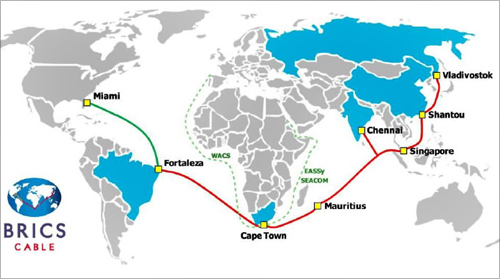

A hugely ambitious initiative designed to boost international communication between cities and global access to high-speed internet is the BRICS Cable Project.
As the acronym suggests, this initiative aims to connect the BRIC markets and the United States with a 34,000 kilometre two-fiber pair submarine cable with capacity of 12.8Tbit/s via cities like Jacksonville (USA), Fortaleza (Brazil), Cape Town (South Africa), Port Louis (Mauritius), Chennai (India), Singapore, Shantou (China) and Vladivostok (Russia).
With enhanced internet connectivity, the cable would boost trade links and economic competitiveness.
Most Competitive Cities in India
Latest report has been founded on four pillars - the factor conditions, demand conditions, context for strategy and rivalry, and the quality of supporting and related industries.
 India's capital, New Delhi (with a score of 69.732) has emerged the most competitive city in the country as per the India City Competitiveness Report-2012, compiled by the Institute for Competitiveness (IFC) that conducts studies in this area for use by businesses and governments.



Faridabad, with its high growth has drastically improved in its ranking and holds the 29th spot. Similarly Guwahati recorded a wide improvement in its position," says the report, unveiled Wednesday to coincide with Singapore Prime Minister Lee Hsien's visit here.

Mumbai (67.856) The fifth edition of the India City Competitiveness Report is based on a model that has been established by celebrated management guru, Michael E. Porter, Bishop William Lawrance University Professor, based at Harvard Business School.

Chennai (62.323) Regarding New Delhi, the report says the city has managed to demonstrate a phenomenal growth over a period of time by balancing demand and development in equal measure. The two areas it is found lagging in are administrative and institutional support.

Hyderabad (61.782) The report also says that Noida, another city with close proximity to New Delhi, is now giving tough competition to the metros, even as Pune and Ahmedabad, which had very high.

Kolkata (61.464) Among the smaller cities, while Coimbatore, Mysore, Madurai and Guwahati climbed up, Surat, Lucknow, Agra and Allahabad dropped in their rankings.

Gurgaon (61.167) "Undoubtedly, Indian cities have the required potential to make their mark across the globe. this is clearly evident with igh urbanization rate of these cities and by the trend of their growth," says the report. However, it is required that Indian cities work on their strong.

Bengaluru (61.100) Porter's model is founded on four pillars -- the factor conditions, demand conditions, context for strategy and rivalry, and the quality of supporting and related industries. These are further divided into 12 sub-pillars to give information on 50 top cities.

Noida (60.406) "Cities are drivers of any economy. Their growth will enhance the growth of states and eventually that of the country. In the past few years, they have risen from their age-old shells and proving their potential on the global front," says IFC chair Amit Kapoor.

Pune (59.854) When benchmarked globally, Indian cities have much to catch up. Delhi, which takes the top slot in the country, is benchmarked at 46.7 -- which is way below 71.4 for New York, 70.4 for London, 55.2 for Shanghai and 69.3 for Hong Kong.
A Pre-Nuptial Agreement
Three years earlier, when a Bangalore-based investment banker refused to marry as her boyfriend wanted to enter into a prenuptial contract. Six months before, when her marriage was being fixed with another person, he insisted on a prenuptial pact, too. With more working couples getting married, and both having accumulated a certain amount of wealth, the fear of losing the already-created and future wealth in case of a separation is driving most of them for such contracts.According to legal experts, as many as 20 per cent of marriages in metros have couples insisting there be some protection of their wealth before they say, 'I do'.
 This is more common among wealthy business families, as they want to demarcate the rights of the couples in terms of property.
"Yes, it has become common in India. But, mostly, people are just following the US norm blindly. What they don't understand is the fact that there is no such law in India,"
That is, a prenuptial agreement comes under the Contract Act. In case of a legal dispute, the Marriage Act would supersede it.
What is a Pre-Nuptial Agreement?
 A prenuptial agreement is a contract that would-be marrying partners sign, laying out terms and conditions for distribution of financial assets, property, alimony or maintenance, monthly compensation and so on, in the event of a divorce.
A big advantage of a prenuptial pact is it forces couples to have that all-important financial discussion before marriage.
Issues that can be efficiently dealt with in a prenuptial pact range from divorce settlements and prevention of disputes, regarding joint accounts and custody issues of children after the dissolution of a marriage. Another important benefit is that the agreements offer protection from the spouse's debts, if any.
 How is it done?
For making a prenuptial contract, both partners need to set out all their assets and liabilities clearly on paper. They could also add the assets and debt they might create after marriage.
Then, they could discuss how all or joint assets and liabilities be divided if the marriage dissolves. Once the separation and share is mutually decided, both parties can sign and approve the same and maintain it. This will involve zero cost, unless the lawyer charges a fee.
If you want sanctity to it, the individuals could get it verified and signed by their own lawyers or together get it stamped and certified by a notary. Here, stamp duty will apply depending on the state you are in and a small fee for the notary.
In India?
In India, prenuptial agreements are not governed by the marriage laws, says Sandeep Nerlekar, managing director & chief executive officer (CEO), Warmond Trustees & Executives, as marriages here are not considered agreements.
However, under Section 10 of the Indian Contract Act, prenuptial agreements have as much sanctity as any other contract, oral or written.
Experts say, India has various laws governing marriages and so for a contract to hold good will be possible only under statutory provisions. Therefore, such contracts might not be binding in the Indian context.
For instance, if the wife says she will have no right over the husband's property, according to the Stamp Duty and Registration Act, for properties costing over Rs 100, she will have to file a relinquishment of property with the sub registrar only then can she not claim her share in the property later, explains Gupta.
Courts do take cognizance of a prenuptial agreement if both parties had agreed. For instance, if you take the marriage discord to court and request that assets be divided according to the contract you made, the court may agree.
Otherwise, divorce norms override prenuptial contracts, says Delhi-based lawyer P S Dhingra, consultant & CEO, Dhingra Group of Consultants.

Additionally, children born from such marriages have right over the father's assets even if the wife has agreed to not have any right over the husband's assets.
There are no cases as yet, say experts, where contracts have been upheld as there are cases where partners disagree to comply by the contract.
And, there are cases where women earn more than the men and still ask for compensation, which men do not agree to.

"Yes, it has become common in India. But, mostly, people are just following the US norm blindly. What they don't understand is the fact that there is no such law in India,"
That is, a prenuptial agreement comes under the Contract Act. In case of a legal dispute, the Marriage Act would supersede it.
What is a Pre-Nuptial Agreement?
 A prenuptial agreement is a contract that would-be marrying partners sign, laying out terms and conditions for distribution of financial assets, property, alimony or maintenance, monthly compensation and so on, in the event of a divorce.
A big advantage of a prenuptial pact is it forces couples to have that all-important financial discussion before marriage.
Issues that can be efficiently dealt with in a prenuptial pact range from divorce settlements and prevention of disputes, regarding joint accounts and custody issues of children after the dissolution of a marriage. Another important benefit is that the agreements offer protection from the spouse's debts, if any.

For making a prenuptial contract, both partners need to set out all their assets and liabilities clearly on paper. They could also add the assets and debt they might create after marriage.
Then, they could discuss how all or joint assets and liabilities be divided if the marriage dissolves. Once the separation and share is mutually decided, both parties can sign and approve the same and maintain it. This will involve zero cost, unless the lawyer charges a fee.
If you want sanctity to it, the individuals could get it verified and signed by their own lawyers or together get it stamped and certified by a notary. Here, stamp duty will apply depending on the state you are in and a small fee for the notary.
In India?
In India, prenuptial agreements are not governed by the marriage laws, says Sandeep Nerlekar, managing director & chief executive officer (CEO), Warmond Trustees & Executives, as marriages here are not considered agreements.
However, under Section 10 of the Indian Contract Act, prenuptial agreements have as much sanctity as any other contract, oral or written.
Experts say, India has various laws governing marriages and so for a contract to hold good will be possible only under statutory provisions. Therefore, such contracts might not be binding in the Indian context.
For instance, if the wife says she will have no right over the husband's property, according to the Stamp Duty and Registration Act, for properties costing over Rs 100, she will have to file a relinquishment of property with the sub registrar only then can she not claim her share in the property later, explains Gupta.
Courts do take cognizance of a prenuptial agreement if both parties had agreed. For instance, if you take the marriage discord to court and request that assets be divided according to the contract you made, the court may agree.
Otherwise, divorce norms override prenuptial contracts, says Delhi-based lawyer P S Dhingra, consultant & CEO, Dhingra Group of Consultants.

Additionally, children born from such marriages have right over the father's assets even if the wife has agreed to not have any right over the husband's assets.
There are no cases as yet, say experts, where contracts have been upheld as there are cases where partners disagree to comply by the contract.
And, there are cases where women earn more than the men and still ask for compensation, which men do not agree to.
Warren Buffet - 3rd Richest Man in the World

1) Warren bought his first share at age 11 and he now regrets that he started too late!
2) He bought a small farm at age 14 with savings from delivering newspapers.
3) He still lives in the same small 3 bedroom house in mid-town Omaha, that he bought after he got married 50 years ago. He says that he has everything he needs in that house. His house does not have a wall or a fence.
4) He drives his own car everywhere and does not have a driver or security people around him.
5) He never travels by private jet, although he owns the world's largest private jet company.
6) His company, Berkshire Hathaway, owns 63 companies. He writes only one letter each year to the CEOs of these companies, giving them goals for the year. He never holds meetings or calls them on a regular basis.
7) Warren Buffet has given his CEO's only two rules.
Rule number 1: Do not lose any of your share holder's money.
Rule number 2: Do not forget rule number 1.
8) He does not socialize with the high society crowd. His past time after he gets home is to make himself some pop corn and watch television.
9) Bill Gates, the world's richest man met him for the first time only 5 years ago. Bill Gates did not think he had anything in common with Warren Buffet. So he had scheduled his meeting only for half hour. But when Gates met him, the meeting lasted for ten hours and Bill Gates became a devotee of Warren Buffet.
10) Warren Buffet does not carry a cell phone, nor has a computer on his desk.
11) His advice to young people: Stay away from credit cards and invest in yourself.
12) He has donated $31 billion (85% of his fortune) to charity.