


Showing posts with label Technology. Show all posts
Showing posts with label Technology. Show all posts
World's Top 10 Infrastructure Projects
KPMG's second edition of the 'Infrastructure 100: World Cities Edition', showcases 100 of the most innovative and inspiring urban infrastructure projects from around the world.
This study provides insight into the innovations that make them 'Cities of the Future' - places where people want to live and do business, says KPMG.
The aim of Infrastructure100 is to showcase and celebrate one hundred examples of great projects underway in cities around the world.
Of the 100 projects, 10 were selected by a global judging panel as being the most noteworthy within each project category.
This study provides insight into the innovations that make them 'Cities of the Future' - places where people want to live and do business, says KPMG.
The aim of Infrastructure100 is to showcase and celebrate one hundred examples of great projects underway in cities around the world.
Of the 100 projects, 10 were selected by a global judging panel as being the most noteworthy within each project category.
1. Urban Mobility: East Side Access, New York City, United States of America


2. Global Connectivity: Delhi-Mumbai Industrial Corridor, Delhi to Mumbai, India


 The $90 billion project will stretch across seven states and link the nation's capital, Delhi, with the financial capital, Mumbai.
The sheer scale and far-reaching impact of the project impressed the judges with plans including a high-speed rail line for freight, a six-lane expressway and a 4,000 megawatt power station.
The idea is to develop centres of industrial production along the length of the corridor. The project plan includes nine industrial zones and 24 new cities.
3. Urban Regeneration: Oresund Regional Development, Denmark and Sweden

The Oresund Regional Development project creates a cross-border economic zone between Sweden and Denmark, focused on Malmo and Copenhagen.
The two cities are connected by an impressive new international crossing and share a considerable amount of physical infrastructure.
The aim is to continue to foster growth and connectivity via the proposed 18 kilometer Fehmarnbelt Tunnel, which will bring Germany and Scandinavia closer together.
The aim is to continue to foster growth and connectivity via the proposed 18 kilometer Fehmarnbelt Tunnel, which will bring Germany and Scandinavia closer together.

4. Education: Princess Nora Bint Abdul Rahman University for Women, Riyadh, Saudi Arabia

Princess Nora Bint Abdul Rahman University for Women was widely lauded by the judges and is considered a major step in obtaining equal access to education for women in the Middle East.
The self-contained campus will cover 8 million square meters just outside Riyadh and accommodate 40,000 students.
The self-contained campus will cover 8 million square meters just outside Riyadh and accommodate 40,000 students.
The university will have the capacity to accommodate 60 per cent of the city's high-school graduates and will offer degrees in medicine, pharmacy, management and IT.
According to the judges, the project has a "generational theme" and its effect will ripple across the whole country for years to come.
According to the judges, the project has a "generational theme" and its effect will ripple across the whole country for years to come.
5. Healthcare: Royal London Hospital, London, UK

The Royal London Hospital at White chapel in the United Kingdom is one of the oldest operating healthcare facilities in England.
The Victorian-era hospital – often associated with the grittiness of the capital's East End – was redeveloped and funded through a 1.1 billion pound PFI.
Following its redevelopment, the new hospital reopened its doors in March 2012 and is now one of Britain's largest, most advanced healthcare facilities.

The new hospital has 1,248 beds, an increase of 186 on the previous facility, with over 40 percent in single rooms with en suite facilities.
Wards are light and airy with natural ventilation and separate areas for women and men, and the 22 operating theaters are one-third larger than their predecessors.
6. Water: Tuas II Desalination Plant, Tuas, Singapore

In Singapore, the Tuas II Desalination Plant will serve a vital function, delivering 318,500 cubic meters (70 million gallons) of water per day for a 25-year concession period from 2013 to 2038.
Singapore currently relies on rainfall and imports from neighboring Malaysia for freshwater supplies.

The wealthy city-state has made several investments in recent years to become more independent and meet the needs of an increasing population.
7. New and Extended Cities: Tianjin Eco City, Tianjin, China

In the Far East, judges were impressed with Tianjin Eco-city being developed with "practical" technology on challenging arid terrain in northern China.

The city is an ambitious economic collaboration between China and Singapore to pilot a more liveable alternative to some of the country's polluted megacities.
With an advanced light rail system, solar energy and smart grid technology, Tianjin eco-city is set to create a new benchmark among global cities.
8. Recycling and Waste Management: Deep Tunnel Sewerage System, Kranji to Changi, Singapore

The Deep Tunnel Sewerage System in Singapore has been under construction since 2000 and is scheduled for completion in 2020.

The massive scheme has been designed to address all of the city-state's long-term needs for used water collection, treatment, reclamation and disposal.
The award-winning system works entirely by gravity, thus eliminating the need for pumping stations and the risks of used water overflows as well.
9. Urban Energy Infrastructure: Cidade Inteligente, Buzios, Brazil
Brazil is at the forefront of intelligent energy systems with its impressive Cidade Inteligente Buzios project.


Among the benefits for consumers are the possibilities of having discounted energy prices dependent on time of usage, consumption control of household appliances, energy savings through the installation of new LED street lighting and increased energy efficiency in public buildings.
10. Communications Infrastructure: BRICS Cable Project, South Africa and Mauritius
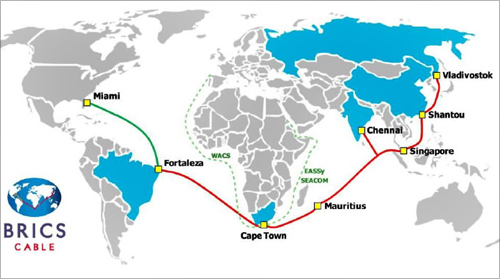

A hugely ambitious initiative designed to boost international communication between cities and global access to high-speed internet is the BRICS Cable Project.
As the acronym suggests, this initiative aims to connect the BRIC markets and the United States with a 34,000 kilometre two-fiber pair submarine cable with capacity of 12.8Tbit/s via cities like Jacksonville (USA), Fortaleza (Brazil), Cape Town (South Africa), Port Louis (Mauritius), Chennai (India), Singapore, Shantou (China) and Vladivostok (Russia).
With enhanced internet connectivity, the cable would boost trade links and economic competitiveness.
Why images through Night Vision Goggles look Green?
The characteristic green tint is by design, for a few reasons. First, device makers have experimented with a few different colors and found that the different shades that make up the monochrome night vision image are most accurately perceived and distinguished when they’re green. In other words, while the night vision images you’ve seen in Silence of the Lambs and Call of Duty might seem a little clunky, green presents a night vision device wearer with the most accurate and user-friendly picture possible. What’s more, because the eye is most sensitive to light wavelengths near 555 nanometers – that is, green – the display can be a little dimmer, which conserves battery power.

Who Invented Night Vision?
The first practical night vision devices were developed in Germany in the mid-1930s and were used by both German tanks and infantry during World War II. U.S. Military scientists had simultaneously developed their own night vision devices that first saw use during WWII and the Korean War.These “Generation 0” devices used active infrared to brighten up a scene. Soldiers carried an IR illuminator to shoot a beam of near-infrared light that then reflected off objects and bounced back to the lens of their scope and created a visible image of what they were looking at. The illuminators used by the German Nachtjägers, or “night hunters”, were about the size of dinner plates and required a large power supply carried on the soldier’s back.
The technology made huge leaps in the following decades, and by the time the U.S. entered the Vietnam War, many troops were outfitted with passive “starlight scopes” that used image-intensifying tubes to amplify available ambient light (usually from the moon and stars, hence the name) and produce an electronic image of a dark area.
This “Generation 1” technology is still around today in the more budget-friendly consumer-grade night vision devices. Military and police forces have upgraded to successive generations of tech with new improvements over the years, but image intensifying night vision – there’s also another flavor, thermal imaging, but image intensification is almost always the kind you see in movies and games – still works on the same basic principles as these early models.

Who Invented Night Vision?
The first practical night vision devices were developed in Germany in the mid-1930s and were used by both German tanks and infantry during World War II. U.S. Military scientists had simultaneously developed their own night vision devices that first saw use during WWII and the Korean War.These “Generation 0” devices used active infrared to brighten up a scene. Soldiers carried an IR illuminator to shoot a beam of near-infrared light that then reflected off objects and bounced back to the lens of their scope and created a visible image of what they were looking at. The illuminators used by the German Nachtjägers, or “night hunters”, were about the size of dinner plates and required a large power supply carried on the soldier’s back.
The technology made huge leaps in the following decades, and by the time the U.S. entered the Vietnam War, many troops were outfitted with passive “starlight scopes” that used image-intensifying tubes to amplify available ambient light (usually from the moon and stars, hence the name) and produce an electronic image of a dark area.
This “Generation 1” technology is still around today in the more budget-friendly consumer-grade night vision devices. Military and police forces have upgraded to successive generations of tech with new improvements over the years, but image intensifying night vision – there’s also another flavor, thermal imaging, but image intensification is almost always the kind you see in movies and games – still works on the same basic principles as these early models.
Know your processor

What's a Core i7 and why is it better than an i3? There's also Core i5? And what about AMD? Figuring out your processor is half the battle of buying a PC.
What is a core?
In layman's language, a core is the part of the processor responsible for carrying out calculations needed to execute programs. When a chip has multiple cores, it means it can process multiple instructions at the same time, thus increasing the software's speed.
Intel has three main Core families...
Core i3: Has two cores and Hyper Threading (HT) - a technology that simulates more cores than actually exist on the processor. This improves performance of programs that can utilize the extra cores. The i3, however, lacks Turbo Boost for extra muscle when needed. Ideal for average users.
Core i5: Has four cores, but no HT. Consumes a little more power than i3. The i5 comes with Turbo Boost that allows for an increase in clock speeds in the range of 300 to 400MHz. For example, if the processor has a speed of 2.8GHz, Turbo Boost will push the speed up to 3.1GHz. Ideal for power users

Core i7: Has four to six cores, with HT. The least power-efficient, but the most powerful. Ideal for professionals who work in 3D or edit multimedia.
AMD..
While AMD doesn't have Intel's raw performance, it's still good enough for everyday tasks and comes at a cheaper price. Of the lot, two AMD processors deserve mention.
The A 3870K: Has four cores and is part of the Fusion series. It promises better graphics at budget prices. Ideal for average users who want a bit of a gaming boost.
The FX 8150: Has eight cores and is part of the Bulldozer series. Not power-efficient and a bit slow in less demanding tasks. But works great in intensive processing tasks like video encoding and 3D modeling. Ideal for a professional on a budget.
What is Ivy Bridge?
Every year, Intel comes out with a new class of processors. The new Ivy Bridge is the third generation of Core i processors, and can be identified by model numbers that begin with 3. In terms of performance, Ivy Bridge processors average 10% faster than last year's Sandy Bridge processors. They are also more power-efficient.
Last but not the least, What is Trinity?
Trinity is AMD's new architecture, replacing the current A series Llano CPUs like A3870K. They can be identified by model numbers that begin with 5. They will be slightly better in general computing like web-browsing or office work, but offer vastly better performance for 3D gaming.
Biggest Tech Failures in History
Microsoft Windows Me
The "mistake" edition Backtracking on plans to make Windows 98 the last OS before switching to NT builds, Microsoft shipped two more 9x-based platforms: Windows 98 SE (April '99) and Windows Me (September '00). The former was a revamped version of Win98, while the latter was an awkward interim release that arrived shortly after the venerable Windows 2000. Me was unstable and had fewer features than 98 and 2k, making it a tough sell and a horrible OS experience out of the box.Sega Dreamcast
The game console that could, but wasn't
With radical new features including a modem and a VMU memory card, the Dreamcast was successful when it launched in 1998 and 1999. Sadly, that momentum promptly stalled with intense competition from the PlayStation 2 and Xbox, which, among other advantages, used DVDs for games instead of a proprietary format. Some two years later, a tattered Sega ceased production of its innovative console.
Microsoft's Tablet PC
The right idea, the wrong approach

Bill Gates, at the time CEO of Microsoft, presented the Tablet PC in 2001 as the next major evolution of the personal computer. Microsoft's approach was to offer a Windows XP-based slate or convertible laptop that added pen input, handwriting and voice recognition functionality. Needless to say, this didn't work very well and as a result didn't sell either. The Tablet PC was too bulky, the input was unintuitive, and the software lacked refinement, even to this day.
Nokia N-Gage
Ahead of its time or blatantly poor execution?

In 2003, Nokia fused a lackluster gaming platform with a cumbersome cellphone and set its crosshairs on the Game Boy Advance. The N-Gage's vertical screen was cramped, swapping games meant removing the battery and its cellphone was oriented sideways. Perhaps even more discouraging, it had fewer games than Nintendo's handheld while costing over double at $300. In its first weeks, the device was outsold 100 to 1 by the GBA.
HD-DVD
Casualty of the high-def format war

Streaming is the present and future of video, but for a while if you wanted to watch proper high-resolution media, you had to place your bets on either next-generation format: Blu-ray or HD-DVD. Eventually, the former came on top and HD-DVD quickly faded into oblivion (launched in 2006, died in 2008), leaving behind about a million obsolete players, including the popular Xbox 360 add-on unit.
UMPCs
Small form factor of fail

Ultra-mobile PCs saw a few different iterations, from Sony's sexy but impractical VAIO U to the equally impressive but yet awkward OQO UMPCs. Trumpeted as the next-generation pocketable Windows devices, UMPCs never received mainstream adoption -- not least because of their use of Vista. A few years later, the iPhone would prove smartphones were the true future of mobile.
Palm Foleo
Palm almost beat Asus to the netbook

The Foleo was a mini-notebook in development at Palm for a few months before being cancelled. It had a lot in common with the first commercially successful netbook (Asus Eee): small footprint, low price, as well as decent battery life and connectivity. On the other hand, the Foleo's pending doom was written on the wall. For example, it would have depended on a Treo smartphone to fully function (a la Blackberry Playbook, meaning total failure). Despite those shortcomings, we believe Palm missed out big should they have polished their short-lived project further. Netbooks were widely successful Asus sold hundreds of thousands of units in no time.
Windows Vista
Six flavors of fail

After repeated setbacks, Windows Vista finally launched with a confusing array of six editions during the slow PC sales month of January. Ironically, part of the final delay was used to "crank up" Vista's security and uptight security became one of critics' main complaints. There were also numerous software incompatibilities, various performance issues (gaming/file transfers/battery life), and it failed to deliver promised features such as WinFS.
DRM on PC Games
No one benefits from restrictive DRM

DRM has been cooking for years but 2008 brought with it many controversial examples -- most notably Spore, which used a modified version of SecuROM for online authentication and limited users to three installs. After being slammed with thousands of one-star Amazon reviews and two class-action suits, EA released a SecuROM-free copy on Steam in December '08, but not before Spore became the most pirated game of the year.
MySpace
Just because Facebook is now worth $1000b

Until 2008, Facebook was the second largest player in social networking, trailing behind MySpace by a considerable margin. A year after being acquired by News Corp. in 2005, the service was in such privileged position that it beat Google as the most visited website in the US. Thanks to a combination of poor decision-making, horrible design and user experience, and a lack of focus on core social components, MySpace failed to capitalize on its position, leaving Facebook to attract a wider user demographic in the long haul.
Sony PSP Go
No 99 cents games for you

In 2009, Sony set out to explore the uncharted waters of digital distribution. Unfortunately, existing PSP owners didn't want to "upgrade" and ditch their UMD collections, newcomers were discouraged by the PSN's weak catalog and neither wanted to part with $250 for a handheld. Factor in the rapid adoption of smartphones with their infinite sea of 99-cent games and the PSP Go's voyage was arguably doomed from the outset. Only time will tell if the PS Vita shares the same fate.
Google Wave and Google Buzz
The web's giant lack of social skills

Google is arguably the most powerful force on the web, but with Facebook as well as other social and mobile newcomers threatening its dominance, the company has repeatedly tried to become a top social destination. Before Google+ there was Buzz which failed to gain momentum despite having close ties to Gmail. Google Wave also caused a stir initially, but it failed in its attempt to create a clever communication tool that had the potential of replacing IM and email.
Android Tablets, HP TouchPad, Blackberry Playbook
Until they are able to make a dent on iPad's market share

Google has arguably done a great job with Android and those efforts have paid off on the smartphone front. On the tablet side however, not so much. Even with great partners and multiple hardware iterations, somehow it feels like Android keeps lagging behind Apple's iPad. The recent delays in getting Android 4.0 ICS to all outgoing tablets makes matters even more visible. But at least they are trying to make a dent on iPad's sales. Meanwhile, HP's TouchPad and the Blackberry Playbook were a complete disaster, from lacking basic functionality, to their complete mismanagement and premature cancellation.
The "mistake" edition
Backtracking on plans to make Windows 98 the last OS before switching to NT builds, Microsoft shipped two more 9x-based platforms: Windows 98 SE (April '99) and Windows Me (September '00). The former was a revamped version of Win98, while the latter was an awkward interim release that arrived shortly after the venerable Windows 2000. Me was unstable and had fewer features than 98 and 2k, making it a tough sell and a horrible OS experience out of the box.Sega DreamcastThe game console that could, but wasn't
With radical new features including a modem and a VMU memory card, the Dreamcast was successful when it launched in 1998 and 1999. Sadly, that momentum promptly stalled with intense competition from the PlayStation 2 and Xbox, which, among other advantages, used DVDs for games instead of a proprietary format. Some two years later, a tattered Sega ceased production of its innovative console.
Microsoft's Tablet PC
The right idea, the wrong approach
Bill Gates, at the time CEO of Microsoft, presented the Tablet PC in 2001 as the next major evolution of the personal computer. Microsoft's approach was to offer a Windows XP-based slate or convertible laptop that added pen input, handwriting and voice recognition functionality. Needless to say, this didn't work very well and as a result didn't sell either. The Tablet PC was too bulky, the input was unintuitive, and the software lacked refinement, even to this day.
Nokia N-Gage
Ahead of its time or blatantly poor execution?
In 2003, Nokia fused a lackluster gaming platform with a cumbersome cellphone and set its crosshairs on the Game Boy Advance. The N-Gage's vertical screen was cramped, swapping games meant removing the battery and its cellphone was oriented sideways. Perhaps even more discouraging, it had fewer games than Nintendo's handheld while costing over double at $300. In its first weeks, the device was outsold 100 to 1 by the GBA.
HD-DVD
Casualty of the high-def format war
Streaming is the present and future of video, but for a while if you wanted to watch proper high-resolution media, you had to place your bets on either next-generation format: Blu-ray or HD-DVD. Eventually, the former came on top and HD-DVD quickly faded into oblivion (launched in 2006, died in 2008), leaving behind about a million obsolete players, including the popular Xbox 360 add-on unit.
UMPCs
Small form factor of fail
Ultra-mobile PCs saw a few different iterations, from Sony's sexy but impractical VAIO U to the equally impressive but yet awkward OQO UMPCs. Trumpeted as the next-generation pocketable Windows devices, UMPCs never received mainstream adoption -- not least because of their use of Vista. A few years later, the iPhone would prove smartphones were the true future of mobile.
Palm Foleo
Palm almost beat Asus to the netbook
The Foleo was a mini-notebook in development at Palm for a few months before being cancelled. It had a lot in common with the first commercially successful netbook (Asus Eee): small footprint, low price, as well as decent battery life and connectivity. On the other hand, the Foleo's pending doom was written on the wall. For example, it would have depended on a Treo smartphone to fully function (a la Blackberry Playbook, meaning total failure). Despite those shortcomings, we believe Palm missed out big should they have polished their short-lived project further. Netbooks were widely successful Asus sold hundreds of thousands of units in no time.
Windows Vista
Six flavors of fail
After repeated setbacks, Windows Vista finally launched with a confusing array of six editions during the slow PC sales month of January. Ironically, part of the final delay was used to "crank up" Vista's security and uptight security became one of critics' main complaints. There were also numerous software incompatibilities, various performance issues (gaming/file transfers/battery life), and it failed to deliver promised features such as WinFS.
DRM on PC Games
No one benefits from restrictive DRM
DRM has been cooking for years but 2008 brought with it many controversial examples -- most notably Spore, which used a modified version of SecuROM for online authentication and limited users to three installs. After being slammed with thousands of one-star Amazon reviews and two class-action suits, EA released a SecuROM-free copy on Steam in December '08, but not before Spore became the most pirated game of the year.
MySpace
Just because Facebook is now worth $1000b
Until 2008, Facebook was the second largest player in social networking, trailing behind MySpace by a considerable margin. A year after being acquired by News Corp. in 2005, the service was in such privileged position that it beat Google as the most visited website in the US. Thanks to a combination of poor decision-making, horrible design and user experience, and a lack of focus on core social components, MySpace failed to capitalize on its position, leaving Facebook to attract a wider user demographic in the long haul.
Sony PSP Go
No 99 cents games for you
In 2009, Sony set out to explore the uncharted waters of digital distribution. Unfortunately, existing PSP owners didn't want to "upgrade" and ditch their UMD collections, newcomers were discouraged by the PSN's weak catalog and neither wanted to part with $250 for a handheld. Factor in the rapid adoption of smartphones with their infinite sea of 99-cent games and the PSP Go's voyage was arguably doomed from the outset. Only time will tell if the PS Vita shares the same fate.
Google Wave and Google Buzz
The web's giant lack of social skills
Google is arguably the most powerful force on the web, but with Facebook as well as other social and mobile newcomers threatening its dominance, the company has repeatedly tried to become a top social destination. Before Google+ there was Buzz which failed to gain momentum despite having close ties to Gmail. Google Wave also caused a stir initially, but it failed in its attempt to create a clever communication tool that had the potential of replacing IM and email.
Android Tablets, HP TouchPad, Blackberry Playbook
Until they are able to make a dent on iPad's market share
Google has arguably done a great job with Android and those efforts have paid off on the smartphone front. On the tablet side however, not so much. Even with great partners and multiple hardware iterations, somehow it feels like Android keeps lagging behind Apple's iPad. The recent delays in getting Android 4.0 ICS to all outgoing tablets makes matters even more visible. But at least they are trying to make a dent on iPad's sales. Meanwhile, HP's TouchPad and the Blackberry Playbook were a complete disaster, from lacking basic functionality, to their complete mismanagement and premature cancellation.
Airbus Unveils Transparent Airplane
Airbus has unveiled a futuristic concept for a transparent plane that may be everyday air transport in 2050. With its see-through aircraft cabin, passengers of the future will get a window on the world as they fly through the sky. They will be able to see everything to the sides and in front of them.
The concept cabin unveiled at the Royal Observatory in Greenwich, London, would be a bionic structure that 'mimics' the efficiency of the bird bone, claimed the company.
It would provide strength where needed, and also allows for an intelligent' cabin wall membrane, which controls air temperature and can become transparent to give passengers open, panoramic views.The company believes that mid-century passengers might be able to enjoy a game of virtual golf or take part in interactive conferences, while the cabin 'identifies and responds' to travelers' needs.In the 'interactive zone' there are virtual pop-up projections taking passengers to whichever social scene they want to be in, from holographic gaming to virtual changing rooms for active shoppers.The 'smart tech zone' is tailored towards the more functional-orientated passenger with what Airbus describes as 'a chameleon-style offering.'It aims to meet individual needs ranging from a simple to a complete luxury service, but all allowing 'you to continue life as if on the ground'.
"Our research shows that passengers of 2050 will expect a seamless travel experience while also caring for the environment," the Daily Mail quoted Airbus engineering executive vice-president Charles Champion as saying.
"The concept cabin is designed with that in mind, and shows that the journey can be as much a voyage of discovery as the destination," he added.


The concept cabin unveiled at the Royal Observatory in Greenwich, London, would be a bionic structure that 'mimics' the efficiency of the bird bone, claimed the company.
It would provide strength where needed, and also allows for an intelligent' cabin wall membrane, which controls air temperature and can become transparent to give passengers open, panoramic views.The company believes that mid-century passengers might be able to enjoy a game of virtual golf or take part in interactive conferences, while the cabin 'identifies and responds' to travelers' needs.In the 'interactive zone' there are virtual pop-up projections taking passengers to whichever social scene they want to be in, from holographic gaming to virtual changing rooms for active shoppers.The 'smart tech zone' is tailored towards the more functional-orientated passenger with what Airbus describes as 'a chameleon-style offering.'It aims to meet individual needs ranging from a simple to a complete luxury service, but all allowing 'you to continue life as if on the ground'.
"Our research shows that passengers of 2050 will expect a seamless travel experience while also caring for the environment," the Daily Mail quoted Airbus engineering executive vice-president Charles Champion as saying.
"The concept cabin is designed with that in mind, and shows that the journey can be as much a voyage of discovery as the destination," he added.
What is NFC (Near-Field Communication)
 NFC, or near-field communication, is a variant of RFID, or radio frequency identification. It is an ultra short-range wireless technology that allows communication and data exchange between two devices held in tight proximity - about 4 cm apart.
NFC-enabled smartphones have the potential to replace credit cards. This is because NFC phones pack a smart chip - a complex 80-character code that is really hard to crack. Such a device can safely store confidential credit card details and be handy for purchases on the go.
Frost & Sullivan predicts the technology will revolutionise e-commerce and drive over $150 billion worth of transactions by 2015, bulk of which is expected to be powered by NFC phones.
NFC can be deployed in ticketing services, rural banking, interactive and targeted advertising, healthcare, hospitality, libraries and pharmacies. In fact, an NFC phone could become the single-key to access to your car, home and office.
How NFC works...
Any device, a cellphone, a camera or a watch, can be equipped with an NFC 'initiator', which is simply an antenna that can store data. If the device is an NFC smartphone, the 'initiator' and 'target' (an NFC reader) need to be up close for data exchange to happen.

The 'reader' is attached to a point-of-sale (PoS) terminal or cash-register in a retail store that accepts NFC payments. A simple wave of the phone can pay for a purchase. Alternatively, two NFC phones can be tapped lightly to exchange business cards.
Geeks claim that in standby mode, a well-designed NFC solution does not consume any power. And since transactions happen in seconds, the power drain is not huge.
Globally, NFC adoption is picking up via smartphones. RIM, Nokia, Samsung and HTC have unveiled NFC smartphones. Apple iPhone5 is tipped to support NFC too. Google Wallet - a mobile payments technology that can be downloaded on some US mobile networks - is growing the NFC ecosystem. Payment trials have also begun in Australia, Singapore and China.
NFC in India
The technology is still in its infancy here. As of now, Reserve Bank of India does not recognise NFC mobile payment transactions and PoS terminals accepting NFC payments don't exist. But NFC-enabled phones like Apple's iPhone 4, BlackBerry's Touch Bold 9900 and Curve 9360, Samsung's Nexus S and Galaxy S II and Nokia's C7, 700, 701 and 600 are available. For NFC to take off, RBI has to frame norms and banks, carriers, credit card companies, apps developers and PoS terminal makers have to team up.
But awareness levels are growing and NFC is making some waves in entertainment. Shah Rukh Khan starrer Ra.One was the first movie to be marketed by Nokia using NFC technology. Armed with an NFC phone, you can download the movie content by merely tapping the device on a NFC-tagged movie poster at a Nokia priority outlet or a partner multiplex.
Different from Bluetooth...
Bluetooth is also a short-range high frequency wireless technology but one that allows interaction between communication devices as much as 10 meters apart.
5 Technology Startups That Changed The World
Perhaps the way technology has changed lives, it would have never been anticipated. A few of them have in fact changed the entire shape of the world and many are in the same contention. They are producing completely novel industries and landing up everyone in a situation of pure awe.So, we shall now tell you about some of these out-of-the-world technologies:
The World Wide Web: It is not the internet; though without it it's improbable that you can upload your birthday photos on Facebook. It was invented in 1989 by Tim Berners-Lee and in 1992 was released; it actually got popularity a year later, as the first web browser – Mosaic Web was launched. Berners-Lee could perhaps have made huge loads of cash from patenting and licensing his creation, he didn’t keep it with him though.
Napster: It isn’t one of the lot’s music sellers. We’re talking about the unique Napster. The makers of Napster gave all reasons for Broadband to succeed apart from troubling big shot labels. Napster was incredibly simple to use and extremely helpful, and p2p sharing for the very first time came into the scene. It is all thanks to Napster we now have iTunes, Bittorrent and Skype. It is great tech when we know it is made by a student.
Hotmail: The innovative Hotmail was an incredible piece of tech. By carrying desktop software to the internet and eventually turning out to be a grand hit, Hotmail successfully escorted in the web 2.0 world of internet apps – likes of Google Maps, Google Docs, Flickr, etc. have build up onto its success. Currently it is under Microsoft and a part of the Windows Live program.

iPhone: The iPhone is like just another phone or is it? It has email, media, games, internet, Wi-Fi and added facilities yet it is a tour de force. Apple has just done what nobody else can do; it has taught each of its rivals that “This is the way to do it, mate.” Apple has made a lot of companies look dwarf. It has such a great band of developers – they have made something unthinkable. So, players – watch out – Apple’s coming to get you!
Wii: For all the gaming freaks, perhaps I don’t need to tell you about the Nintendo Wii Remote. The console in itself is the daddy of all others. Its guts are absolutely undersized when put against its rivals such as Xbox 360 and PlayStation 3. But what makes Wii, Wii is its motion-sensor controller. Wow, you act like punching your opponent in the face and the player in the game actually does it.
The World Wide Web: It is not the internet; though without it it's improbable that you can upload your birthday photos on Facebook. It was invented in 1989 by Tim Berners-Lee and in 1992 was released; it actually got popularity a year later, as the first web browser – Mosaic Web was launched. Berners-Lee could perhaps have made huge loads of cash from patenting and licensing his creation, he didn’t keep it with him though.
Napster: It isn’t one of the lot’s music sellers. We’re talking about the unique Napster. The makers of Napster gave all reasons for Broadband to succeed apart from troubling big shot labels. Napster was incredibly simple to use and extremely helpful, and p2p sharing for the very first time came into the scene. It is all thanks to Napster we now have iTunes, Bittorrent and Skype. It is great tech when we know it is made by a student.
Hotmail: The innovative Hotmail was an incredible piece of tech. By carrying desktop software to the internet and eventually turning out to be a grand hit, Hotmail successfully escorted in the web 2.0 world of internet apps – likes of Google Maps, Google Docs, Flickr, etc. have build up onto its success. Currently it is under Microsoft and a part of the Windows Live program.
iPhone: The iPhone is like just another phone or is it? It has email, media, games, internet, Wi-Fi and added facilities yet it is a tour de force. Apple has just done what nobody else can do; it has taught each of its rivals that “This is the way to do it, mate.” Apple has made a lot of companies look dwarf. It has such a great band of developers – they have made something unthinkable. So, players – watch out – Apple’s coming to get you!
Wii: For all the gaming freaks, perhaps I don’t need to tell you about the Nintendo Wii Remote. The console in itself is the daddy of all others. Its guts are absolutely undersized when put against its rivals such as Xbox 360 and PlayStation 3. But what makes Wii, Wii is its motion-sensor controller. Wow, you act like punching your opponent in the face and the player in the game actually does it.
Difference Between Laptop and Notebook
Netbook
A notebook computer is designed to provide mobile computing that won't break your back yet still offer all the power the mobile users requires for work and some leisure pursuits.
This portability normally comes at a price.
The level of miniaturization involved comes at a cost and high end notebooks can prove to be quite expensive.
A standard notebook has the following features:
1. Ultralight. Less weight is better.
2. 4 - 5 hour battery life.
3. No internal floppy drive.
4. Minimal graphics subsystem.
5. No internal DVD or CD system.
6. 12" - 14" TFT screen.
7. Low profile (thin).
8. Integrated modem and network connection.
9. Smallest possible keyboard that retains functionality.
10. Low power consumption Celeron/Centrino or Sempron style processor.
Laptop

Now for the laptop computer.
Again look at the name.
A laptop is designed to sit on your lap and you can therefore expect it to be quite large and loaded down with features and power.
The standard laptop computer would have some ,if not all, of the following features:
1. 14" - 17" (widescreen) TFT screen.
2. Nvidia GeForce or ATI Radeon graphics subsystem.
3. Internal DVD-ROM or DVD-RW drive
4. Large full featured keyboard.
5. 3 hour+ battery life.
6. Upgrade able.
7. Integrated modem, network, Bluetooth and Wi-Fi capabilities.
8. High quality integrate audio and speaker system.
9. Low power consumption, high performance Intel Centrino style processor.
From reading the above information you'll see that the notebook is the exact opposite of the laptop.
Notebooks offer reasonable power and extreme portability.
Laptops are designed to be capable of replacing an entire desktop PC if necessary whilst still offering desktop performance in a mobile platform.
A notebook computer is designed to provide mobile computing that won't break your back yet still offer all the power the mobile users requires for work and some leisure pursuits.
This portability normally comes at a price.
The level of miniaturization involved comes at a cost and high end notebooks can prove to be quite expensive.
A standard notebook has the following features:
1. Ultralight. Less weight is better.
2. 4 - 5 hour battery life.
3. No internal floppy drive.
4. Minimal graphics subsystem.
5. No internal DVD or CD system.
6. 12" - 14" TFT screen.
7. Low profile (thin).
8. Integrated modem and network connection.
9. Smallest possible keyboard that retains functionality.
10. Low power consumption Celeron/Centrino or Sempron style processor.
Laptop
Now for the laptop computer.
Again look at the name.
A laptop is designed to sit on your lap and you can therefore expect it to be quite large and loaded down with features and power.
The standard laptop computer would have some ,if not all, of the following features:
1. 14" - 17" (widescreen) TFT screen.
2. Nvidia GeForce or ATI Radeon graphics subsystem.
3. Internal DVD-ROM or DVD-RW drive
4. Large full featured keyboard.
5. 3 hour+ battery life.
6. Upgrade able.
7. Integrated modem, network, Bluetooth and Wi-Fi capabilities.
8. High quality integrate audio and speaker system.
9. Low power consumption, high performance Intel Centrino style processor.
From reading the above information you'll see that the notebook is the exact opposite of the laptop.
Notebooks offer reasonable power and extreme portability.
Laptops are designed to be capable of replacing an entire desktop PC if necessary whilst still offering desktop performance in a mobile platform.
Top 11 Expensive Phones
11. Ulysse Nardin’s The Chairman – up to $49,500
The Chairman by Ulysse Nardin is the world’s most expensive Android smartphone, and includes both a touch screen and a physical number pad. The Ulysse Nardin name is most often associated with luxury watches and that fact shows in the Chairman’s sophisticated design. The volume controls look like watch buttons and the crown between them can actually be wound to generate power for the device. In fact, the phone features a kinetic rotor power system visible through the backplate.
10. Nokia 8800 Arte with pink diamonds - $134,000

Designed by Peter Aloisson, this solid 18k white gold phone features over 680 pink and white brilliant cut diamonds totaling over 21.5 carats. Some of the phone’s features are a 3.15 MP camera with autofocus and video, a music player, Bluetooth and voice memo.
9. Peter Aloisson’s iPhone Princess Plus - $176,400

The Princess Plus got its name from the Princess cut used on 138 of the 318 diamonds on its surface. The other 180 diamonds on the phone were brilliant-cut. In total, the phone has 17.75 carats of diamonds set in 18k white gold around its rim. The iPhone Princess Plus is worth $176,400 while the somewhat more pedestrian “Brilliants only” version sold for $66,150.
8. Sony Ericsson Black Diamond – $300,000

The price of this phone comes from actual state of the art technology instead of a bunch of shiny rocks—but that doesn’t mean it lacks visual appeal. OLED technology underneath the polycarbonate skin that covers the phones entire face gives the 4 megapixel screen a borderless look. The mirror finish gives the phone a sleek, futuristic look.
7. Vertu Signature Cobra - $310,000

This gaudy phone is so exclusive that only eight will ever be made. Designed by French jeweler Boucheron, the Signature Cobra is made with two diamonds, two emeralds and 439 rubies. For buyers who are only filthy rich, rather than obscenely rich, twenty-six of the less flashy (read: no rubies) Signature Python phones will be available for a mere $115,000. Both phones will feature the real draw—they have frikkin’ snakes on them. Awesome.
6. Gresso Luxor Las Vegas Jackpot – $1 million

This ultra-exclusive phone, limited to only three units, truly lives up to its name. Not only is it extraordinarily expensive, but its Egypt-inspired design will look right at home in the hands of a Vegas high-roller. The phone features 45.5 carats of black diamonds decorating the bezel and a back panel made from 200-year-old African blackwood—the most expensive wood in the world. As if that weren’t enough to ensure the Jackpot a place among the world’s most expensive mobile phones, each key is cut from a hand-polished sapphire crystal. All of these luxurious materials are set in a 180-gram solid gold frame.
5. The Diamond Crypto Smartphone – $1.3 million

Created by luxury accessory producer Peter Aloisson of Moscow-based JSC Ancort, this luxury smartphone’s price stems from the platinum body, the cover adorned with 50 diamonds—including eight that are rare blue diamonds. Additionally, the Ancort logo and the navigation key are made of 18k rose gold. Built on the Windows CE, this expensive cell also features a high-resolution color TFT display and a 256 bit cryptographic algorithm. This expensive mobile phone features SMS, MMS, E-mail and Internet capability, WAP, JAVA support and even a media player.
4. GoldVish ‘Le Million’ Piece Unique - $1.3 million

Guinness World Records certified GoldVish SA’s ‘Le Million’ Piece Unique on January 29th, 2008. The Geneva-based luxury communications company’s expensive mobile phone was designed by Emmanuel Gueit as an addition to the Illusion Collection. The phone is made of 18k white gold and set with 20 carats of VVS1 (only microscopically flawed) diamonds. The phone also features Bluetooth, 2 GB of storage, FM radio, a digital camera and MP3 playback. This expensive cell phone is available only by special order.
3. Peter Aloisson’s Kings Button iPhone - $2.4 million

The Kings Button iPhone is, surprisingly, a jewel-bedecked iPhone. This time, however, Aloisson had the iPhone 3G to play with—and, apparently, a bit of a bigger budget. One hundred and thirty-eight brilliant-cut diamonds line the sides of the phone, but the real prize is the home button—a rare 6.6 carat white diamond.
2. Goldstriker iPhone 3GS Supreme – $3.2 million

Stuart Hughes of Goldstriker International is known for giving luxury devices such as phones and video game consoles the “Supreme” treatment—covering them with gold and diamonds—and the iPhone is no exception. The iPhone 3GS Supreme features a casing made from 271 grams of solid 22k gold and a screen trimmed with fifty-three 1-carat diamonds. The home button is covered with a single rare 7.1-carat diamond. That’s not all, though—the iPhone 3GS Supreme comes in a chest carved from a single block of granite and sports Kashmir gold and an interior lining made with Nubuck top grain leather.
1. Stuart Hughes iPhone 4 Diamond Rose Edition – $8 million

If you thought his iPhone 3GS Supreme was impressive, check out the latest iPhone from Stuart Hughes–the iPhone 4 Diamond Rose Edition. Hughes has recreated the infamous antenna band that wraps around the sides of the latest iPhone, as well as the backplate, using rose gold. The band is adorned with 100 carats of flawless diamonds, and the Apple logo is formed with fifty-three more diamonds. Once again, the home button gets the most love–it’s made of platinum and features a rare 7.4-carat pink diamond.
The phone comes in an imperial pink 7-kilogram chest cut from a single block of granite and lined with nubuck top-grain leather. It also comes with an 8-carat flawless diamond that can be used in place of the pink one.
The Chairman by Ulysse Nardin is the world’s most expensive Android smartphone, and includes both a touch screen and a physical number pad. The Ulysse Nardin name is most often associated with luxury watches and that fact shows in the Chairman’s sophisticated design. The volume controls look like watch buttons and the crown between them can actually be wound to generate power for the device. In fact, the phone features a kinetic rotor power system visible through the backplate.
10. Nokia 8800 Arte with pink diamonds - $134,000
Designed by Peter Aloisson, this solid 18k white gold phone features over 680 pink and white brilliant cut diamonds totaling over 21.5 carats. Some of the phone’s features are a 3.15 MP camera with autofocus and video, a music player, Bluetooth and voice memo.
9. Peter Aloisson’s iPhone Princess Plus - $176,400
The Princess Plus got its name from the Princess cut used on 138 of the 318 diamonds on its surface. The other 180 diamonds on the phone were brilliant-cut. In total, the phone has 17.75 carats of diamonds set in 18k white gold around its rim. The iPhone Princess Plus is worth $176,400 while the somewhat more pedestrian “Brilliants only” version sold for $66,150.
8. Sony Ericsson Black Diamond – $300,000
The price of this phone comes from actual state of the art technology instead of a bunch of shiny rocks—but that doesn’t mean it lacks visual appeal. OLED technology underneath the polycarbonate skin that covers the phones entire face gives the 4 megapixel screen a borderless look. The mirror finish gives the phone a sleek, futuristic look.
7. Vertu Signature Cobra - $310,000
This gaudy phone is so exclusive that only eight will ever be made. Designed by French jeweler Boucheron, the Signature Cobra is made with two diamonds, two emeralds and 439 rubies. For buyers who are only filthy rich, rather than obscenely rich, twenty-six of the less flashy (read: no rubies) Signature Python phones will be available for a mere $115,000. Both phones will feature the real draw—they have frikkin’ snakes on them. Awesome.
6. Gresso Luxor Las Vegas Jackpot – $1 million
This ultra-exclusive phone, limited to only three units, truly lives up to its name. Not only is it extraordinarily expensive, but its Egypt-inspired design will look right at home in the hands of a Vegas high-roller. The phone features 45.5 carats of black diamonds decorating the bezel and a back panel made from 200-year-old African blackwood—the most expensive wood in the world. As if that weren’t enough to ensure the Jackpot a place among the world’s most expensive mobile phones, each key is cut from a hand-polished sapphire crystal. All of these luxurious materials are set in a 180-gram solid gold frame.
5. The Diamond Crypto Smartphone – $1.3 million
Created by luxury accessory producer Peter Aloisson of Moscow-based JSC Ancort, this luxury smartphone’s price stems from the platinum body, the cover adorned with 50 diamonds—including eight that are rare blue diamonds. Additionally, the Ancort logo and the navigation key are made of 18k rose gold. Built on the Windows CE, this expensive cell also features a high-resolution color TFT display and a 256 bit cryptographic algorithm. This expensive mobile phone features SMS, MMS, E-mail and Internet capability, WAP, JAVA support and even a media player.
4. GoldVish ‘Le Million’ Piece Unique - $1.3 million
Guinness World Records certified GoldVish SA’s ‘Le Million’ Piece Unique on January 29th, 2008. The Geneva-based luxury communications company’s expensive mobile phone was designed by Emmanuel Gueit as an addition to the Illusion Collection. The phone is made of 18k white gold and set with 20 carats of VVS1 (only microscopically flawed) diamonds. The phone also features Bluetooth, 2 GB of storage, FM radio, a digital camera and MP3 playback. This expensive cell phone is available only by special order.
3. Peter Aloisson’s Kings Button iPhone - $2.4 million
The Kings Button iPhone is, surprisingly, a jewel-bedecked iPhone. This time, however, Aloisson had the iPhone 3G to play with—and, apparently, a bit of a bigger budget. One hundred and thirty-eight brilliant-cut diamonds line the sides of the phone, but the real prize is the home button—a rare 6.6 carat white diamond.
2. Goldstriker iPhone 3GS Supreme – $3.2 million
Stuart Hughes of Goldstriker International is known for giving luxury devices such as phones and video game consoles the “Supreme” treatment—covering them with gold and diamonds—and the iPhone is no exception. The iPhone 3GS Supreme features a casing made from 271 grams of solid 22k gold and a screen trimmed with fifty-three 1-carat diamonds. The home button is covered with a single rare 7.1-carat diamond. That’s not all, though—the iPhone 3GS Supreme comes in a chest carved from a single block of granite and sports Kashmir gold and an interior lining made with Nubuck top grain leather.
1. Stuart Hughes iPhone 4 Diamond Rose Edition – $8 million
If you thought his iPhone 3GS Supreme was impressive, check out the latest iPhone from Stuart Hughes–the iPhone 4 Diamond Rose Edition. Hughes has recreated the infamous antenna band that wraps around the sides of the latest iPhone, as well as the backplate, using rose gold. The band is adorned with 100 carats of flawless diamonds, and the Apple logo is formed with fifty-three more diamonds. Once again, the home button gets the most love–it’s made of platinum and features a rare 7.4-carat pink diamond.
The phone comes in an imperial pink 7-kilogram chest cut from a single block of granite and lined with nubuck top-grain leather. It also comes with an 8-carat flawless diamond that can be used in place of the pink one.